An off-road camper is capable when its frame, suspension, tires, and power system are built for rough ground and long stays without hookups. That means a galvanized steel chassis, independent suspension, light-truck tires, a high departure angle, and enough water and solar to camp for days. Bigger tires bolted onto a highway trailer do not qualify.
You see it all the time on social media. A shiny camper parked next to a beautiful mountain lake, miles from civilization. It looks like the perfect weekend escape.
But getting to those hidden spots in the United States is not as easy as it looks on video. The best campsites are usually reached via deep ruts, sharp rocks, and muddy hills.
Many campers want to escape crowded, paved RV parks. Some builders respond by putting bigger tires on a standard travel trailer and calling it “off-road ready.”
Bigger tires alone don’t make a capable off-road camper.
Take a highway camper onto a rocky trail, and the cabinets can shake loose, the frame can flex, and the trip can end early. A capable overland camper is engineered from the ground up for that kind of use. For a shorter feature rundown, see 5 essential features every true off-road overland trailer needs.
Four things separate a capable off-road camping trailer from one that only looks the part: the chassis, the suspension, departure angle and tires, and the off-grid systems.
Pillar 1: What Kind of Chassis Does an Off-Road Camper Need?
A camper starts with its frame. If the frame is weak, everything bolted to it pays the price.
Most standard highway campers are built on a “C-channel” frame. If you look at the metal, it is shaped like the letter C. This makes it very lightweight and cheap to build. However, an open C-channel frame loves to twist and flex. When you drive over a large boulder and your camper tilts to one side, a light-duty frame can bend. Over time, that twisting can crack seams and walls.
A stiff frame resists that twisting.
You also want to look at how the metal is protected. Driving on dirt roads throws up rocks that chip away standard paint. Once the paint is gone, the steel starts to rust. A galvanized steel chassis is coated in zinc, which protects the steel from rust far longer than standard paint. The Expedition 500 chassis is heavy-duty galvanized steel.
Pillar 2: Why Does Suspension Matter Off the Pavement?
If the chassis is the foundation, the suspension acts like your camper’s knees. This is where capability shows up first.
Basic trailers use a solid straight axle with leaf springs, the same setup you see on a utility trailer. If the left tire hits a rock, the whole axle tilts, and the shock travels through the entire camper. That shock rattles cabinets loose and breaks gear.
A capable off-road camper uses an independent suspension system. This means the left and right tires operate independently. If the left tire hits a deep pothole, it absorbs the impact on its own while the right tire stays perfectly flat on the ground.
Here is a real-world example. The Expedition 500 from Tribe Trailers uses independent air ride suspension with double-wrapped steel A-arms and nylon bushings. Each tire moves up and down on its own to absorb big bumps, keeping the ride smoother for the camper and everything inside.
See this suspension in person. Request a quote or find a Tribe dealer near you, and compare how each camper handles rough ground before you buy. [ADD: one or two sentences from a Tribe owner or the Peoria team on a trip where the suspension made a difference.]
Pillar 3: Departure Angle and Tires
Ground clearance is obvious. You need the bottom of your camper to sit high enough that it doesn’t scrape on rocks. But ground clearance is only half the battle. You also need to look at the “departure angle.”
The departure angle is how steep a slope the rear of the camper can handle before something drags. It is measured from the ground at the back tire up to the lowest point at the rear of the camper. Imagine driving through a dry riverbed. When your truck climbs up the other side, the back of your camper will dip down toward the dirt. If your departure angle is poor, the rear bumper can dig in and tear off. A capable overland camper keeps its rear end tucked up and out of the way.
Tires also matter. You do not just want big tires. You want thick, heavy-duty rubber.
A good size to look for is a 265/75R16 LT tire, which is what the Expedition 500 runs. The “LT” stands for Light Truck. LT tires have stiffer, stronger sidewalls than standard trailer tires, which helps resist punctures from sharp sticks and jagged rock when you are miles from a tow truck. For more on what separates trail-ready rigs, read what makes a trailer truly off-road capable.
Pillar 4: Off-Grid Systems (Staying Out There)
Getting to the campsite is the fun part. But once you arrive, the camp has to work. A true off-grid camper needs self-sustaining systems so you do not have to rely on city water or shore power.
You need two things to stay comfortable in the wild. You need lots of clean water and reliable electricity.
A camper built for hookups may carry only a small fresh-water tank, which runs dry fast when you are off the grid. A rig built for remote trips carries more. The Expedition 500 carries 42 gallons of fresh water. Ready.gov recommends at least one gallon of water per person per day for drinking and sanitation, and cooking and washing add to that, so 42 gallons covers a small group for several days. On BLM-managed land, dispersed camping is generally limited to 14 days in any 28 days, and limits vary by field office, so plan a refill stop on longer trips.
For electricity, you want a system that charges itself. Look for built-in solar panels. The Expedition 500 carries four 100W roof panels (400W total) feeding two 100Ah deep-cycle lead-acid batteries.
Off-Road Camper Capability Checklist
If you are shopping around, ask the right questions. Bring this checklist when you shop to see whether a camper is actually capable.
| Feature to Check | What You Want | What to Avoid |
| Frame Style | Stiff, heavy-duty steel frame | Light-duty open C-channel |
| Rust Protection | Galvanized steel | Standard paint only |
| Suspension | Independent A-Arm (Air Ride or Coil) | Solid Axle with Leaf Springs |
| Tires | Light Truck (LT) All-Terrain or Mud | Standard Highway Trailer Tires |
| Water Capacity | Enough for every person for the whole trip (at least 1 gallon per person per day) | A tank that runs dry before the trip ends |
| Power System | Deep-cycle battery bank (lithium or lead-acid) with 200W+ solar | A single starting-type battery |
Which Tribe Rig Fits Your Trips?
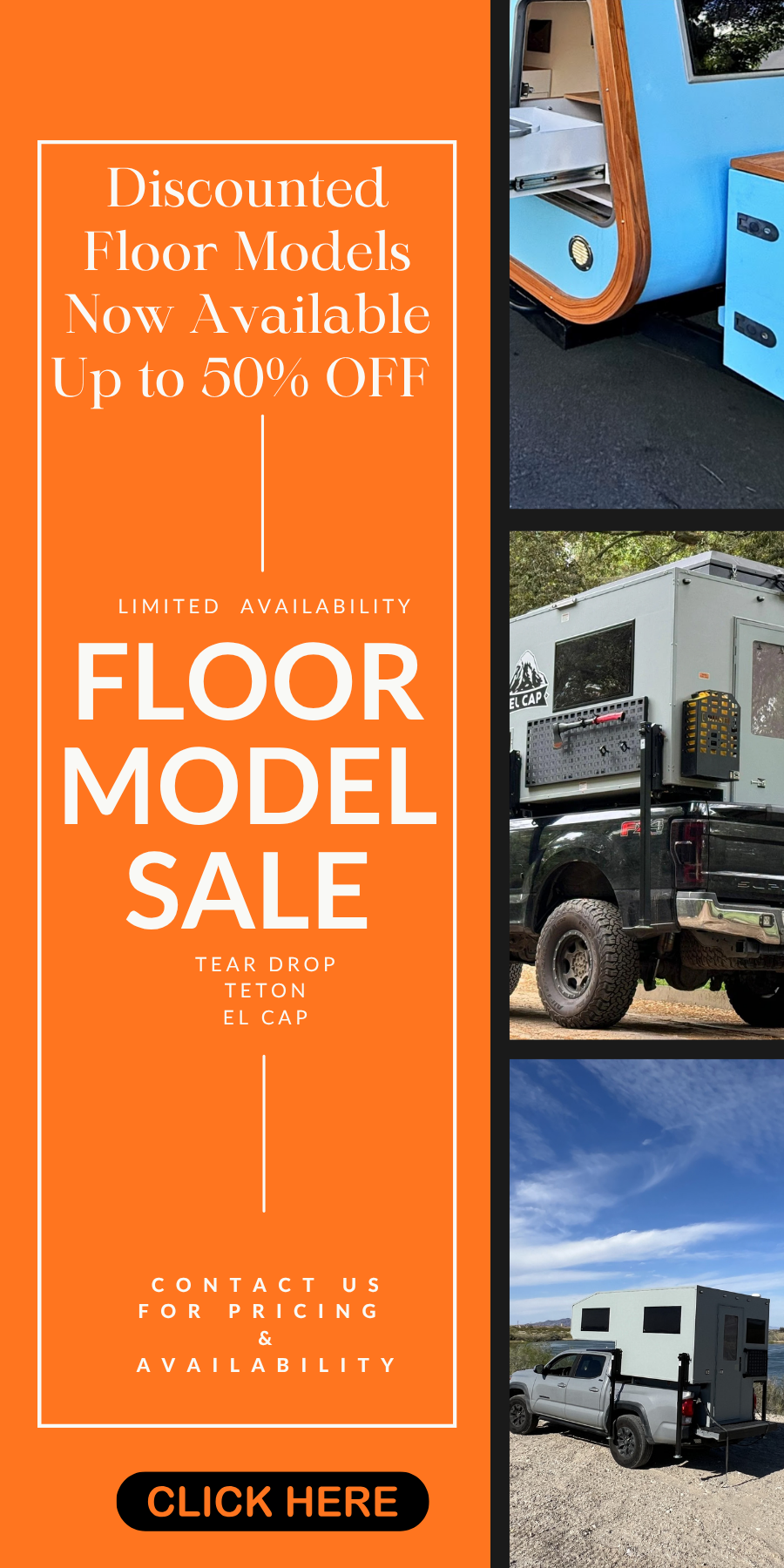
Capability does not have to mean a six-figure build. At the time of writing, the floor discount models page lists a Teton for $15,000 (down from $25,000) and an El Cap truck bed camper for $29,000 (down from $35,000), each a single floor model sold as-is, plus two Traveler teardrop trailers at $11,000 (down from $22,000). Check current availability before you plan around any of them.
If you would rather not tow, the El Cap is a truck bed camper with a 1,600 lb tare weight. It includes a rooftop tent, a 100Ah lithium battery, a 12V diesel heater, a 10,000 BTU dual-burner stove, and a 270-degree awning. Check your truck’s payload and bed dimensions against the El Cap’s 127 x 83 x 81 inch size before you commit.
Tribe Trailers is a family-owned and operated company with its manufacturing facility in Peoria, Arizona. Our President, Brett Maister, is an avid off-road racer.
Ready to see which Tribe fits your trips? Request a quote or call 1-866-447-7895.
Frequently Asked Questions
1. What is the difference between a normal RV and an off-road camper?
A normal RV is built for smooth highways and paved parking lots. It uses a thin frame and basic street tires. An off-road camper is engineered like a tough off-road truck. It features a heavy-duty steel frame, special independent suspension, and thick all-terrain tires to handle deep mud, rocks, and washboard dirt roads without falling apart.
2. Do I need a massive truck to tow an off-road camping trailer?
Not necessarily. It depends on the camper. The Expedition 500 has a tare weight of 3,660 lb, so compare your vehicle’s rated towing capacity with the fully loaded weight of any trailer (tongue weight included), and leave a margin. If you would rather not tow, the El Cap truck bed camper has a 1,600 lb tare weight and rides in your truck bed. See what vehicle you need to tow the Expedition 500.
3. Why is independent suspension so important for off-grid travel?
Independent suspension allows each wheel on the trailer to move up and down on its own. If you drive over a large rock with your left tire, the suspension absorbs the hit while the right tire stays flat. This helps keep the trailer stable and reduces the shaking your gear takes inside the cabin.
4. How long can an off-grid camper actually stay out in the wild?
It all depends on your water and power usage. With a rig like the Expedition 500, which holds 42 gallons of fresh water and has 400W of solar power, a small group that conserves water can plan on several days between refills. Longer trips mean planning a water stop.
5. What does the term departure angle mean for a trailer?
The departure angle measures how steep a slope the rear of the trailer can clear before something drags. It runs from the ground at the back tire up to the lowest point at the rear of the trailer. A high departure angle means the back of the trailer is angled upward. This prevents the rear bumper from dragging in the dirt when you drive up a steep hill or out of a ditch.
6. Are real off-road campers hard to maintain?
Maintenance is routine, much like a standard vehicle. You need to keep the suspension greased, check your tire pressure before a trip, and drain the water tanks before winter freezing hits.
7. Does Tribe Trailers have off-road campers available right now?
floor discount models page lists a limited number of single-unit floor models sold as-is, including a Teton, an El Cap, and Traveler teardrop trailers. Availability changes, so request a quote or call 1-866-447-7895 to confirm what is in stock.