Short answer: if most of your nights are spent in developed campgrounds with hookups, a traditional RV makes sense. If you want to camp at the end of a dirt road on public land, an off-road travel trailer is the better tool. It gives up some interior space in exchange for ground clearance, independent suspension, and a footprint your truck or SUV can pull down a rough forest road.
When you start shopping for a rig and comparing an RV vs trailer, you run straight into a classic dilemma: do you choose the luxury comfort of a traditional RV, or do you choose the go-anywhere ruggedness of an off-road travel trailer?
It is a tough question because both choices pull you in opposite directions. On one hand, a traditional RV offers plush couches, massive kitchens, and the feel of a condo on wheels. On the other hand, a real off-road travel trailer lets you drive right past crowded campgrounds, cross rocky creeks, and camp on remote public land where huge motorhomes cannot possibly go.
If you choose wrong, you will feel it immediately. Pick a rig with too much luxury and zero trail capability, and you will end up trapped on paved roads. Pick a bare-bones setup with zero comfort, and your family might refuse to join you on your second trip.
Off-grid camping on public land is widely available if your rig can get there. The Bureau of Land Management notes that most BLM lands allow dispersed camping unless an area is posted closed, with stays generally limited to 14 days in any 28-day period.
To help you figure out what belongs in your driveway, we compare both rigs on real-world capability, cost, and tow vehicles, then tackle the three objections buyers raise most.
The Core Conflict: Off-Road Freedom vs. Living Space
To make the right choice, you first need to understand the fundamental difference in how these two types of campers are designed.
A traditional travel trailer or motorhome (like a Class A or Class C motorhome) is built for the highway. It is built to roll down smooth asphalt at 65 miles per hour and plug into shore power and city water at a resort. The moment you pull a 30-foot fiberglass travel trailer onto a rocky forest road, problems begin. The low frame can drag over ruts, washboard vibration works at stapled wood framing and cabinetry, and light-duty trailer tires are prone to punctures on sharp rock.
An off-road travel trailer is engineered from the ground up for the dirt. It starts with a stout steel or aluminum chassis built to handle the twisting loads of rough roads. It rides on independent suspension, so each wheel can move on its own over rocks and potholes. It sits high off the ground on all-terrain or mud-terrain tires, and it connects to your vehicle with an articulating hitch that pivots as the trail shifts. We break down each of these systems in what makes a trailer truly off-road capable.
An expedition RV or heavy-duty trailer trades some indoor square footage for the freedom to go anywhere your four-wheel-drive tow vehicle can reach. You get to camp right at the edge of the canyon instead of in a parking lot ten miles away.
Off-Road Travel Trailer vs. RV: Side-by-Side Comparison
When you look past the sales brochures, how do these two camping styles actually stack up in the real world? Here is a direct look at the specs that matter most when you leave the pavement.
| Feature / Metric | Traditional Highway RV | Rugged Overland Adventure Trailer |
| Ground Clearance | Low (Typically 6 to 9 inches) | High (Typically 16 to 24 inches) |
| Suspension Type | Solid leaf-spring axle (bouncy on dirt) | Heavy-duty independent suspension |
| Off-Road Rating | Paved roads and flat gravel only | Extreme dirt trails, rocks, mud, and river crossings |
| Tow Vehicle Needs | Heavy-duty truck or specialized hitch | Standard mid-size or full-size SUV / Truck |
| Setup Time at Camp | 10 to 20 minutes (leveling jacks, slide-outs) | 5 to 10 minutes (quick deploy kitchens and roofs) |
| Average Base Price | $25,000 to $100,000+ | $18,000 to $45,000+ |
| Fuel Economy Impact | Drops truck MPG by 40% to 50% | Drops truck MPG by only 15% to 25% |
| Storage Flexibility | Requires expensive paid RV storage lot | Compact models can fit in a home garage |
Breaking Down the Top 3 Buyer Objections
Whenever someone is on the fence about choosing between an RV and an off-road travel trailer, three main worries always come up. Here is a straight answer to each one.
1. “Will I have enough living space and comfort?”
This is the number one hesitation for people who are used to traditional RVs. They see an off-road trailer and worry they will feel cramped, especially if it rains for two days straight.
Modern expedition trailers approach interior space differently. Instead of cramming bulky, heavy residential furniture into a box, top-tier off-road travel trailers use smart pop-up roofs, fold-out beds, and modular slide-out systems. You still get a full-size plush mattress, indoor heating, built-in LED lighting, and hot water.
Many models go further. The Tribe Expedition 500, for example, is a hard-sided pop-up with indoor and outdoor kitchens, a diesel heater, air conditioning, 400 watts of roof solar, and a wet bath with a shower and flushable marine toilet. The real lifestyle shift is where you spend your waking hours. With an RV, you spend most of your vacation sitting inside an air-conditioned box. With an adventure trailer, the great outdoors becomes your true living room, while the trailer provides a secure, cozy, and climate-controlled shelter for sleeping and cooking.
2. “Can I manage and maneuver a trailer completely by myself?”
If you plan to travel solo or do not want to argue with your partner every time you park, manageability is a huge deal.
Large traditional RVs are notoriously stressful to back up and maneuver. They have massive blind spots, wide turning radiuses, and high wind resistance that can push you across lanes on the highway. If you drive a 32-foot motorhome down a dead-end trail in the woods, turning around can be nearly impossible without getting stuck in the trees.
A compact off-road travel trailer is dramatically easier to manage. Because it is shorter and narrower, it tracks directly behind your tow vehicle. If you make a wrong turn on a tight mountain trail, you can easily turn around in a standard turnaround loop. Features like the Expedition 500’s electric front jack also make unhitching and setting up camp easier to handle solo.
3. “Is buying a tow vehicle too expensive compared to an all-in-one motorhome?”
Some buyers think: “If I buy a motorized RV, I do not have to buy a separate truck.”
When you compare an RV vs trailer, the financial math usually favors the trailer. A motorized RV comes with its own engine, transmission, brakes, and cooling system. That means you are paying for two engines (your daily driver plus the RV), two insurance policies, and double the mechanical maintenance. When a motorhome engine breaks down, your living space goes into the repair shop with it.
With an off-road travel trailer, you use the truck or SUV you already drive every day. When you arrive at your campsite, you unhitch your trailer to set up camp, and your vehicle is instantly free to run into town for groceries or go tackle rocky 4×4 trails without dragging your living room behind you. If you would rather not tow at all, a truck camper like the Tribe El Cap rides in the bed of the pickup you already own.
Matching Weight Classes with Common Tow Vehicles
You do not need an enormous commercial truck to pull a high-end off-road rig. Many off-road travel trailers are light enough to pair with the mid-size and full-size vehicles people already drive every day.
| Tow Vehicle Model | Vehicle Class | Max Tow Rating | Recommended Trailer Dry Weight | Ideal Trailer Match |
| Toyota 4Runner | Mid-Size SUV | Up to 6,000 lbs | Under 3,200 lbs | Lightweight compact teardrop or pop-up trailer |
| Toyota Tacoma | Mid-Size Truck | Up to 6,500 lbs | Under 3,800 lbs | Mid-size overland camper with slide-out kitchen |
| Ford F-150 | Full-Size Truck | Up to 13,500 lbs | Up to 5,500 lbs | Full-size, multi-sleeper family expedition trailer |
| Ram 1500 | Full-Size Truck | Up to 11,550 lbs | Up to 5,500 lbs | Heavy-duty, all-season expedition trailer with bath |
Tow ratings shown are manufacturer maximums for current-generation models (sources: 2025 4Runner, 2024 Tacoma, 2026 F-150) and vary by engine, drivetrain, and trim, so confirm the rating for your exact configuration. For reference, the Tribe Explorer weighs 1,750 lbs, and the Expedition 500 weighs 3,660 lbs. If the Expedition 500 is on your list, see what vehicle you really need to tow it.
Pro Tip: Always calculate your vehicle’s tongue weight capacity and Gross Combined Weight Rating (GCWR). A common rule of thumb is to keep your loaded trailer weight 15% to 20% below your vehicle’s maximum tow rating so you are not straining the drivetrain on steep mountain climbs. Your owner’s manual has the final word.
Decision Framework: Which One Fits Your Travel Style?
Still trying to make up your mind? Use this quick checklist to match a rig to how you actually travel.
You Should Choose a Traditional RV If:
- You plan to spend 90 percent of your camping nights in developed RV resorts with concrete pads, electricity, and sewer hookups.
- You travel with family members who require a large indoor lounge, big-screen TVs, and residential appliances.
- You do not enjoy driving on bumpy dirt, gravel, or rocky trails.
- You are comfortable paying monthly storage fees to park a tall, 30-foot camper in an off-site lot.
You Should Choose an Off-Road Travel Trailer If:
- You want the freedom to camp anywhere on free public BLM and National Forest lands away from crowds.
- You already own a capable SUV or truck (like a 4Runner, Tacoma, or F-150) and want to use it as your base platform.
- You want a compact rig you can store at home rather than paying high storage bills.
- You want heavy-duty build quality designed to handle years of washboard roads and trail vibration.
Choose the Tool Built for the Job
At the end of the day, a traditional RV is a fantastic tool for resort camping, but it simply was not built to survive the unpredictable conditions of backcountry exploration.
If your dream vacation involves listening to rushing rivers instead of highway traffic, an off-road travel trailer is the superior tool for the job. It gives you the durability to handle rough terrain, the agility to explore narrow trails, and the comfortable shelter you need to rest up for the next day’s adventures.
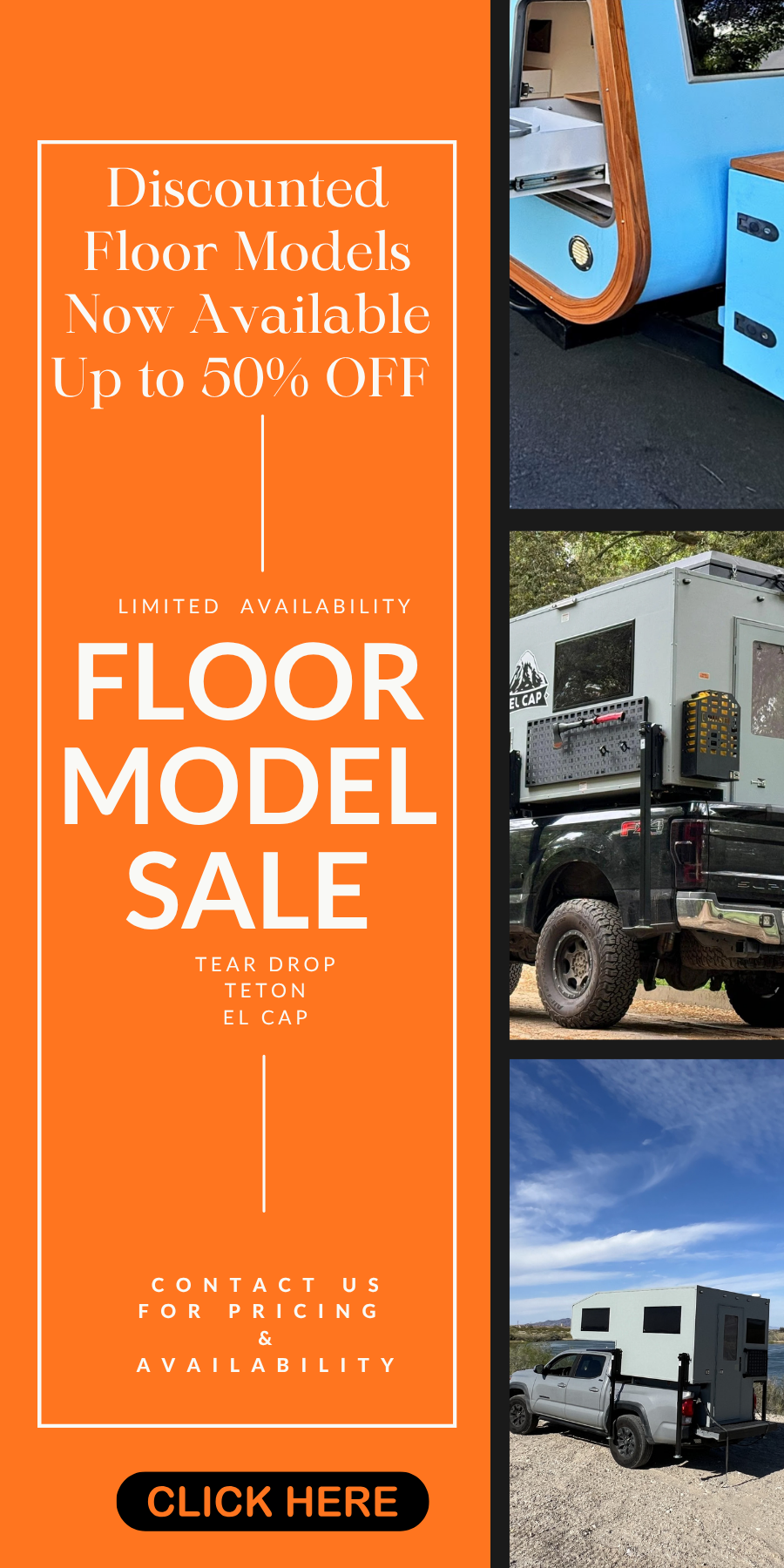
Do not let a fragile camper limit where your journey can take you. Choose a rig purpose-built to go where RVs can’t, pack your gear, and find your own quiet corner of the wilderness. Compare the Expedition 500 and Explorer, browse our current floor discount models, or request a quote to talk through which trailer fits the vehicle you already drive.
Frequently Asked Questions
1. Can a standard travel trailer be converted for real off-road use?
You can make minor modifications (like adding a lift kit or slightly larger tires), but you cannot easily turn a standard travel trailer into a true off-road rig. Standard RVs use thin C-channel frames, stapled wood framing, and standard leaf-spring axles. The constant twisting and harsh vibrations of off-road driving will quickly loosen structural joints, crack window seals, and shake interior cabinetry loose. A true off-road camper is built from the ground up with a rigid chassis and independent suspension.
2. How long can you comfortably stay off-grid in an off-road travel trailer?
With a well-equipped off-road travel trailer, you can comfortably stay off the grid for 5 to 14 days at a time before needing to resupply. Your limiting factors will always be water capacity and food storage. Trailers equipped with 20 to 35 gallons of fresh water, a 12-volt refrigerator, and a rooftop solar charging system can keep your batteries topped up day after day in good sun, so food and drinking water become the real limits. Land rules matter too: dispersed camping on BLM land is generally limited to 14 days in any 28-day period.
3. Do off-road travel trailers hold their resale value better than traditional RVs?
Generally, yes, though exact numbers depend on the brand, condition, and local market. Mass-produced RVs tend to lose value quickly in their first few years because of wear, roof leaks, and high market supply. High-quality off-road travel trailers are built in smaller numbers with rot-resistant materials like aluminum and heavy-duty steel, and they are designed to handle rough use, which helps them stay in demand on the used market. For a closer look, see how expedition trailers and traditional RVs compare on resale value.
4. What is the difference between an articulating hitch and a standard ball hitch?
A standard ball hitch only allows a small amount of side-to-side and up-and-down movement. If your truck leans one way while the trailer tilts the opposite way on a rocky trail, a standard ball hitch can bind, putting heavy twisting loads on the coupler, the hitch, and your tow vehicle. An articulating hitch (like a poly-block or multi-axis coupler) can spin a full 360 degrees and pivot in any direction. This allows the trailer to move freely over severe obstacles without putting those twisting forces on your tow vehicle. The Tribe Expedition 500 comes standard with a fully articulating poly block hitch.
5. Are off-road camping trailers warm enough for winter camping?
Many are. High-end off-road travel trailers are often built for four-season use. Many models feature insulated composite walls and can be equipped with efficient diesel or propane heaters that keep the interior warm and cozy even in sub-freezing conditions. When winter camping, ensure your trailer has protected or heated water lines so your plumbing does not freeze overnight. Our guide to prepping an overland trailer for a winter expedition covers the rest of the checklist.
6. Why is independent suspension so important for off-road trailers?
A traditional straight axle connects both wheels together with a solid metal bar. When one wheel hits a rock, the entire axle tilts, violently shaking the entire trailer. Independent suspension separates the wheels. Each wheel rides on its own arm (trailing-arm and A-arm designs are both common) with its own spring and shock absorbers. When the left wheel hits a boulder or pothole, it absorbs the impact on its own while the right wheel stays flat and stable, providing a smoother ride and protecting your gear inside from damage. The Tribe Expedition 500, for example, uses independent A-arm and air-ride suspension.